
Glamping InvestmentPlanning a Commercial Project
A serious glamping investment starts with the market, the site, project scale, operating season, infrastructure and capital plan — before the final accommodation mix is chosen.
Do not start with “which tent should I buy?”
The first useful questions are larger: who the guest is, why they will choose the location, what nightly rate the market can support, how long the operating season is and how much of the site can be developed without weakening privacy or the guest experience.
Only after those decisions are clear does it make sense to choose the accommodation mix, technical configuration and rollout sequence. Wildhomes can connect that planning stage with glamping resort design, model selection, production and optional installation.
The calculator on this page is an early planning tool. It models gross accommodation revenue and an indicative capital range. It does not calculate net profit, tax, financing returns or guarantee investment performance.
Glamping is growing — but growth does not rescue a weak project.
Market growth supports the category, not every location. The investment still has to work locally: demand, access, guest profile, pricing, operating costs and differentiation remain project-specific.
Estimated European glamping market revenue for 2026.
Projected European glamping market revenue by 2033.
Projected compound annual growth rate for the European glamping market.
Reported as the fastest-growing accommodation segment in Europe for the forecast period.
Source: Grand View Research — Europe Glamping Market Outlook ↗
A viable project aligns demand, land and economics.
A good site can fail with the wrong product mix. A strong product can fail without market demand. Attractive revenue can still fail if infrastructure and operating costs are underestimated.
Who is the guest and why do they come?
Define guest profile, rate expectations, seasonality, competition and the reason the destination deserves an overnight stay.
How much can the land support well?
Access, slope, views, privacy, utilities, drainage, parking and shared facilities determine usable project capacity.
What is the real capital and operating burden?
Accommodation is only one line. Platforms, utilities, logistics, staff, maintenance, marketing and commissions shape the result.
Project capacity is not just a unit count.
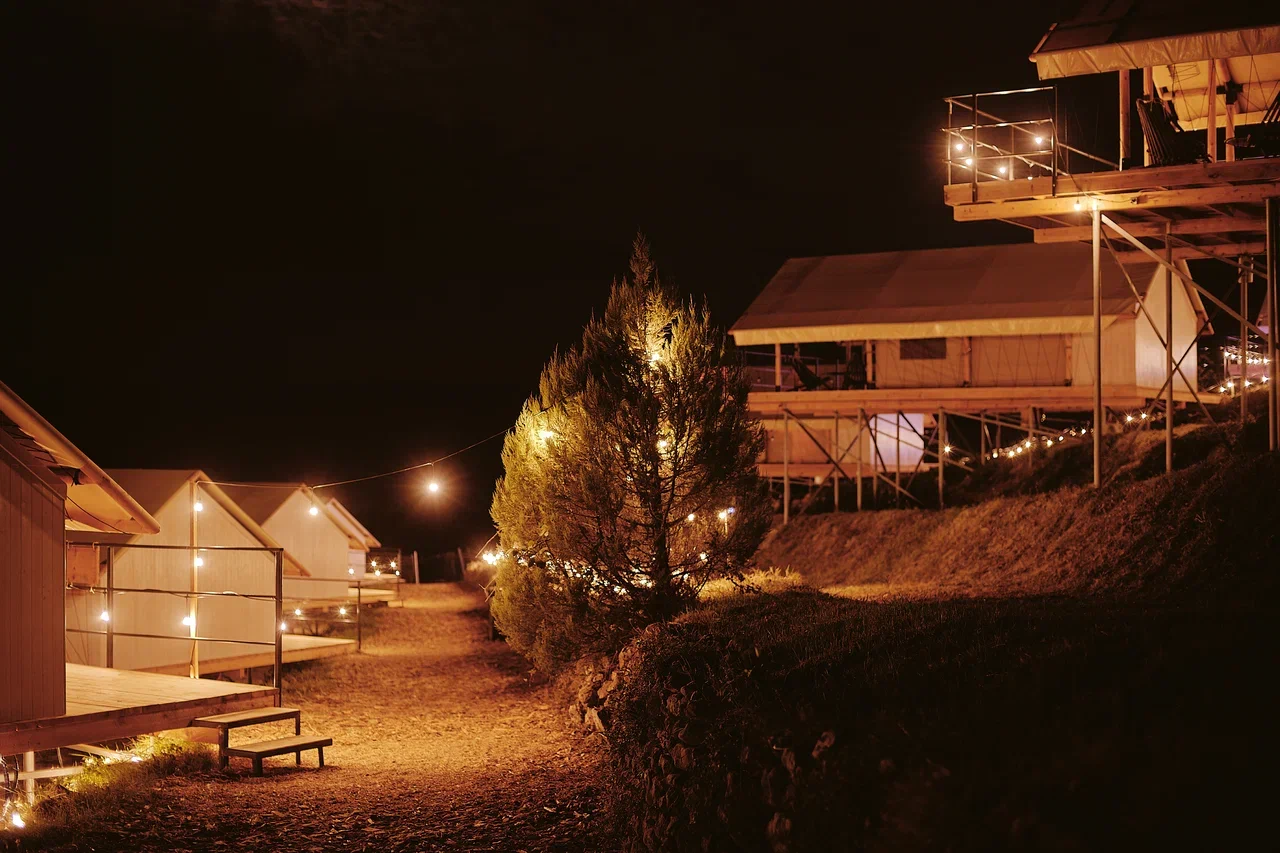
More accommodation does not automatically mean a stronger investment. Over-density can reduce privacy and rate potential, while under-building may make shared infrastructure disproportionately expensive. The full site should be planned before the first phase is ordered.
Separate the accommodation price from the project budget.
Published starting prices
Current Wildhomes base systems start from Prisma at €5,835 excl. VAT. Model and configuration determine the real unit cost.
Separate construction scope
Indicative platform range published in the Wildhomes price guide; site preparation and groundworks remain separate.
Compatible layouts only
Indicative bathroom construction range; sanitary ware and local utility connections are excluded.
Where available
Approximate uplift on the selected base model for compatible Safari, Family, Barn and Dome configurations.
Prices are indicative and exclude VAT where applicable. Transport, installation, import treatment and project-specific options are calculated separately. See the Glamping Tent Price Guide for current published starting prices and inclusions.
Compare gross revenue with an indicative capital range.
Enter your own assumptions. The model uses published Wildhomes ranges for base accommodation, platforms and bathrooms to create an early-stage scenario.
It does not deduct salaries, utilities, OTA commissions, marketing, cleaning, maintenance, tax, financing or other operating expenses.
Investment scenario calculator
Use realistic assumptions for the actual destination.
Before operating expenses, tax, commissions and financing.
Base accommodation + platforms + bathrooms + entered additional CAPEX.
Upper planning range using published indicative component ranges.
How much of the brief is already defined?
A first conversation does not require a finished specification. But the more of these items are known, the faster the project can move from a general idea to a useful accommodation and site strategy.
If the site is still early-stage, start with resort design and site planning rather than forcing a model decision too soon.
Investment planning becomes real through platforms, logistics and repeatable installation.
A commercial project is more than a finished product photo. These short site videos show different parts of the delivery sequence: platform preparation, installation of multiple Prisma units and completed Safari accommodation in a natural setting.
Multiple platforms in construction
Platform preparation for a commercial glamping project before accommodation installation.
Prisma A-frame units installed as one project
Repeatable accommodation only works commercially when site layout, logistics and installation sequence are coordinated.
Safari tents integrated into the landscape
Two finished Safari models show the final relationship between accommodation, outdoor space and the destination.
The catalogue is the starting point — not the ceiling.
Depending on budget, site and guest positioning, compatible Wildhomes systems can move from efficient commercial accommodation to more premium lodge configurations. Layout, bathroom, glazing, finishes and technical options are resolved around the actual project. Furniture supply is not part of the standard Wildhomes scope.
The full resort can be planned before the full resort is built.
Site & market
Test access, utilities, guest demand, pricing logic and seasonality before locking the accommodation mix.
Full capacity
Plan the final site structure first, even when the first commercial phase contains fewer units.
Controlled launch
Open with a coherent first cluster and use real operating feedback before committing to the next expansion.
Add capacity
Scale according to actual occupancy, guest feedback, infrastructure performance and the commercial model.
Move from investment logic to specific project decisions.
Use independent data for the market context — then validate the local business case.
What investors usually need to clarify first.
There is no single project figure. The budget combines accommodation, platforms, bathrooms or technical options, transport, installation, utilities, site works and shared facilities. Wildhomes publishes current starting prices and uses project-specific quotations for the final configuration.
No. It shows a gross accommodation-revenue scenario and an indicative capital range. Net profit requires a separate operating model including staffing, utilities, maintenance, marketing, commissions, tax, financing and other local costs.
Not necessarily. A phased approach can reduce initial capital exposure, but the full-capacity site structure should still be planned in advance so later expansion does not damage circulation, privacy or infrastructure logic.
Yes. Resort design can start with the site, guest profile, scale and functional requirements before the accommodation mix is fixed. This is often more useful for multi-unit hospitality projects than choosing a model first.
Yes, within the technical logic of the selected system. Layout, bathrooms, glazing, openings, finishes and climate configuration can be adapted to the project. Furniture is not part of the standard Wildhomes supply scope.
Share the location, approximate site size, planned number of units, intended operating season, guest concept and any preliminary budget or layout information already available. A finished specification is not required for the first discussion.
Send the location, scale and operating idea — not a finished specification.
Wildhomes can review the project direction, recommend the appropriate next step and connect investment planning with resort design, accommodation configuration, production and optional installation.



